


Affective Feudalism

Affect & Power in Late Capitalism

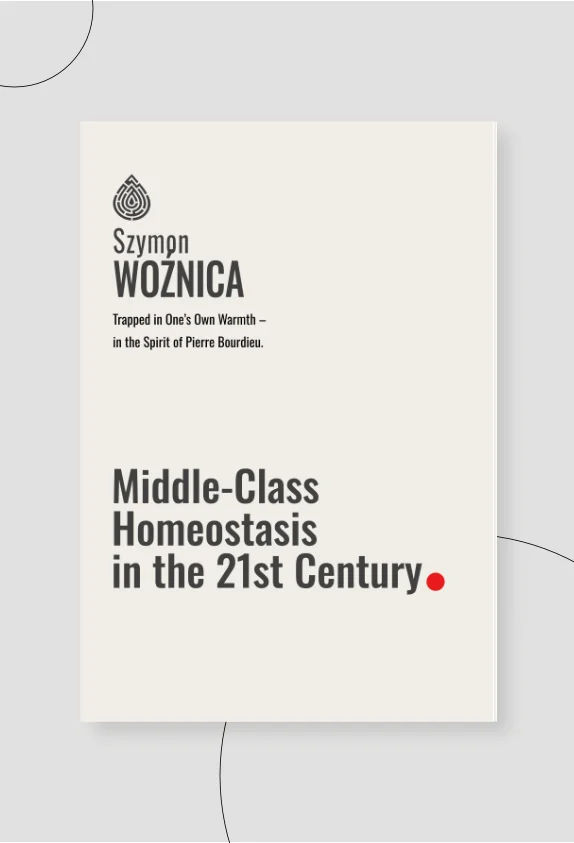
Middle-Class Homeostasis in the 21st Century: Trapped in Its Own Warmth – The Public Edition

Original price was: 27.00 zł.Current price is: 23.00 zł.

Middle-Class Homeostasis is a work of critical theory and systemic diagnosis — a volume in Szymon Woźnica’s Affective Feudalism cycle. Building directly on Pierre Bourdieu’s concept of doxa, the book argues that in 21st-century late capitalism, doxic consensus has ceased to be a merely unconscious feature of the field: it has become an active immunological shield wielded by the middle class. Byung-Chul Han’s diagnosis of the fatigue society is taken seriously — and then challenged. Social immunology has not disappeared, Woźnica argues; it has changed its code from identity-based to affective. The author introduces the concept of doxic immunology: a…

Description

Middle-Class Homeostasis in the 21st Century

Trapped in Its Own Warmth, in the Spirit of Pierre BourdieuSzymon Woźnica | Series: Affective Feudalism

This book asks a question that moves critical theory one step beyond both Bourdieu and Han: what happens when doxa — Bourdieu’s concept of the silent, pre-reflexive acceptance of the rules of the field — becomes an active weapon? When the middle class in late capitalism stops fighting for the future and begins fighting to preserve affective equilibrium?

A Dialogue with Bourdieu and Byung-Chul Han

Woźnica engages in productive, rigorous dialogue with both thinkers. He adopts Han’s diagnosis of the fatigue society as a starting point, then dismantles one of its key claims: Han declares the death of social immunology prematurely. Immunology has not vanished — it has changed its operating code from identity-based to affective. Bourdieu’s doxa, meanwhile, is recast from a descriptive concept of the field into a mechanism of active selection: doxic immunology is a system in which exclusion operates not through prohibition but through the regulation of relational “climate” — vibe, access to circulation, and the management of presence.
A Note from the Author

  • Why This Version Is Different

INTRODUCTION

  • Homeostasis — The Middle Class Trapped in Its Own Warmth

Chapter 1. Han Was Right — But Not Entirely

  • The burnout society as the forefield of a new immunology

Chapter 2. The Dictatorship of the Vibe

  • From sovereign violence to affective selection

Chapter 3. Doxic Immunology

  • Who hands out the oxygen
  • The smart air filter — a short image
  • Not homophily, something more
  • Toward the empirical

Chapter 4. Binary Games

  • Zero or one
  • A scene from the office
  • Every criticism as an immunological attack

Chapter 5. The Geopolitics of Mood

  • Homeostasis as an export product

Chapter 6. The Economy of Exhaustion

  • Ghosting as punishment
  • Silence as punishment
  • Circulation without community
  • Diagnosis

Chapter 7. Affective Cannibalism

  • Why homeostasis eats the future
  • Loyalty to the vibe
  • The trap of one’s own warmth

Chapter 8. The Politics of Abrasiveness

  • A return to negativity and the right to discomfort
  • Three functions of abrasiveness
  • Can the middle class manage it?

Chapter 9. Prisoners of Status and Ceiling Leaders

  • The quiet contract of withdrawal
  • The Ceiling Leader
  • The fear of incompatibility
  • Self-quarantine

Chapter 10. Affective Feudalism as a Political Order

  • Affective apartheid and the twilight of the citizen
  • Three forms of pressure
  • The cannibalism of democracy
  • A sentence without a trial
  • Circulation without community

Chapter 11. The Digital Buffer and the Algorithmic Thermostat

  • The architecture of avoidance
  • The screen as a membrane
  • The algorithm as thermostat
  • The death of the public sphere
  • The thermal death of the political

Chapter 12. Geopolitics Disrupts Homeostasis

  • War, climate, and the bursting of the bubble
  • A stimulus that resists aestheticization
  • Soft denialism
  • Performative care
  • The bursting of the bubble
  • A test of maturity

Chapter 13. The End of the Political

  • The administration of mood and the atrophy of the citizen
  • The citizen as patient
  • Ceiling Leaders in parliament
  • Thermal censorship
  • A shadow theater

Chapter 14. How Bourdieu’s Doxa Became the Middle Class’s Shield

  • No chemistry
  • A consensus of mood instead of reasons
  • Affective habitus

Chapter 15. When Homeostasis Becomes Entropy

  • Work as a performance of temperature
  • The cannibalism of the nervous system
  • Apartheid as an operating cost
  • Heat death
  • The right to switch off the thermostat

CONCLUSION

  • What the Machine Taught Me

Seven Things This Book Says — As Briefly As Possible

  • 1. The middle class doesn’t exclude — it cools you out
  • 2. No one plans it. And that’s the worst part
  • 3. Doxa — what “everyone knows without saying” — works like an air filter
  • 4. Selection is soft — and that’s exactly why it’s cruel
  • 5. The middle class cuts differently from the rest of the world — it defers
  • 6. Homeostasis doesn’t lower exhaustion — it redirects it
  • 7. The bill is most likely paid by someone outside the room

EPILOGUE

  • A World Without Strangers and Without a Future
  • 1. A world without strangers
  • 2. The pack as a soft apparatus of violence
  • 3. When comfort becomes an ideology
  • 4. A world without a future
  • 5. The right to cold

AFTER THE EPILOGUE I

The Gender of Homeostasis. The Affective Tax

  • The cannibalism of care
  • The affective tax in Binary Games
  • Gendered cold strategies
  • Affective patriarchy

APPENDIX 1

What the Simulation Showed — Without the Math

  • Why a simulation at all
  • Five things that really came of it
  • What this model does NOT show

APPENDIX 2

Homeostasis in Organizations. Vibe Management

  • The organization as thermostat
  • Vibe Management and Binary Games
  • The tower and the pack
  • Shadow Assessment — the invisible guillotine
  • Ghosting and the censorship of temperature
  • What HR can do about it
  • Summary

BIBLIOGRAPHY

  • The books this book reads most closely
  • Articles and supplementary texts referenced
  • Data cited in the book
  • A note on the footnotes

ABOUT THE AUTHOR

ABOUT THE PROJECT: AFFECTIVE FEUDALISM

Additional information

Publication year

2026

Pages

144

Format

PDF

Download a free sample chapter to see what awaits you inside.

Download PDF Sample (English)

Pobierz fragment PDF (Polski)

Related products

USD / PLN
PLN Polish złoty