


Description
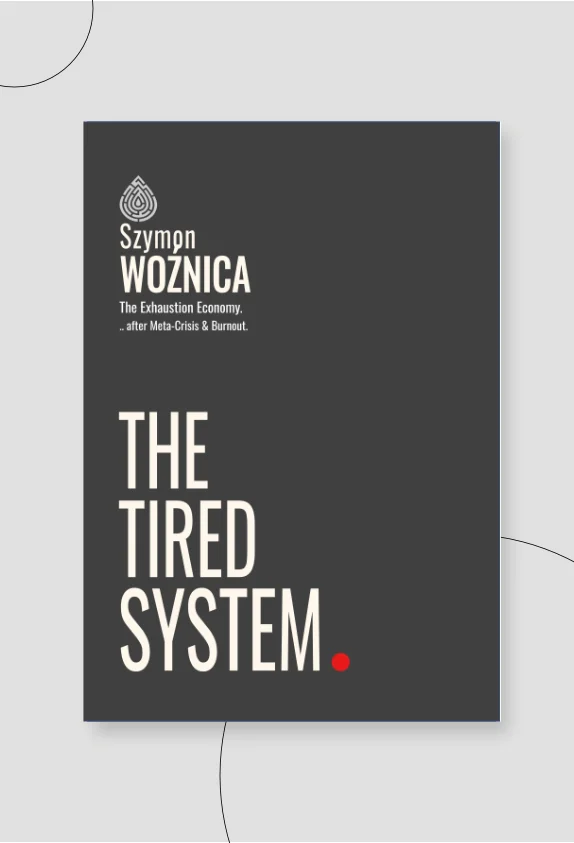
The Tired System and the Theory of Drift
Late capitalism will neither explode nor lock us inside a digital panopticon. It stabilizes in a third way that systemic critics fail to see: by managing the exhaustion of its own participants. The Tired System names this state Drift — a low-energy stability in which everything works, the cost of operation has been privatized, and the exhausted person no longer has the strength to name what is happening to them as a structural problem.
The book combines theoretical essay with the formal validation of an agent-based model. The accompanying tired_system simulation package (Python, MIT license) provides Bayesian validation of five key theses — including the most uncomfortable finding: the correlation between systemic regeneration in private mode (mindfulness apps, wellness programs) and the final capacity for collective coordination is r = −0.92.
The Tired System in Dialogue with Theory
The volume is in polemic with Schmachtenberger, Han, Graeber, Fraser, and Berlant, locating Polish experience of the last decade as a model case of Drift. It introduces the concepts of idle organizational cycles, the implosion of affect, and fatigue-leveraging generator functions. It closes with three headings for operationalizing resistance: rest as a political act, boundaries as the infrastructure of resistance, and abrasiveness as a virtue.
Volume I of the five-volume Affective Feudalism cycle — first in a sequence that can be read independently or as the opening of a broader theory of organizational order built on affective leveraging.
Format: PDF and ePub. The tired_system repository is available separately as an open research resource.