


Description
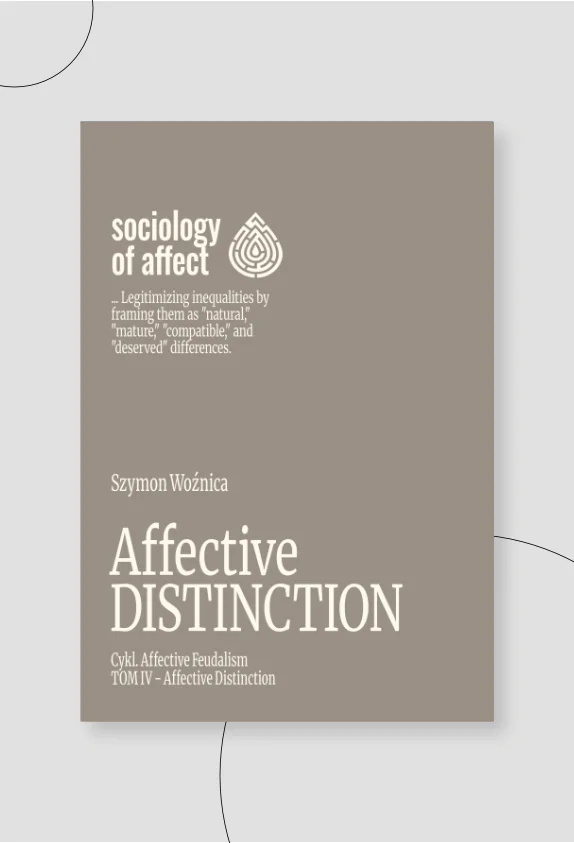
The Distinction of Affect
Volume IV of the Affective Feudalism cycle — strikes against the myth of emotional authenticity from the angle that Pierre Bourdieu, in his Distinction (1979), left open. The book shows that affect — its form, rhythm, legibility, and social digestibility — is not a sphere of freedom from class structure, but the most refined capital through which the middle class inherits inequality.
Affect-Capital as a Class Resource
The central category of The Distinction of Affect — affect-capital — is a passive capacity to emit, in interactions, a signal that is immediately legible, warm, non-irritating, and socially digestible to those around. This is not “emotional intelligence” in the self-help sense of Daniel Goleman. It is a structural position that cannot be reproduced through training, because its foundation lies in decades of primary socialization within a class that already holds affect-capital.
A person with high affect-capital walks into a room and is immediately read as “one of us,” “compatible,” “trustworthy” — before saying a word, before showing a CV, before any substantive discussion. A person with low affect-capital may have identical competence and remain “difficult,” “intense,” “not the right type.”
Social Digestibility as a Mechanism of Exclusion
The contemporary language of HR and corporate culture — “team chemistry,” “cultural fit,” “interpersonal compatibility,” “alignment” — has translated class inequalities into a register that appears emotionally neutral. The Distinction of Affect reconstructs this translation step by step.
Hiring decisions, promotions, and relational sorting are made today on the basis of affect whose distribution is precisely the inverse of what the system declares about itself. Decisions that sound like “managerial intuition” are in fact the recognition of affect-capital — a capital that one either has or does not, and that figures in no diversity policy, because no one has named it.
This is the place where contemporary sociology of emotions should have been for a long time, but has stopped at the level of individual psychology and emotional self-expression.
In Dialogue with the Sociology of Emotions
The volume engages a tradition that partially opened this space but did not close it. From Pierre Bourdieu (Distinction, 1979) it takes the theoretical apparatus and shows that emotions were a field of distinction from the beginning — Bourdieu simply did not yet have the data. From Eva Illouz (Cold Intimacies, Saving the Modern Soul) it takes the diagnosis of emotional capitalism and carries it further, in a direction Illouz ultimately did not want to take. From Arlie Hochschild (The Managed Heart) it takes the concept of emotional labor and shows that emotional labor is not merely labor — it is a class-differentiated competence.
In the background stand Byung-Chul Han, with his critique of transparency and self-exploitation, and Carl Cederström and André Spicer, with their analysis of the wellness syndrome as a political technology. The Distinction of Affect moves the discussion one level deeper: wellness, mindfulness, and emotional intelligence are technologies whose effectiveness depends on already-held affect-capital.
Open Science — the Agent-Based Model
The Distinction of Affect combines theoretical essay with a formal agent-based model (Python, MIT license), documenting the emergence of affective segregation in cognitive organizations — without ideological intent, arising purely from the dynamics of “fit.” The model shows how, in an organization with a formal inclusion policy and no conscious discrimination, stable class-based segregation emerges, grounded purely in differences in affective legibility.
The repository will be published as an open research resource with full replication documentation.
Who The Distinction of Affect Is For
For sociologists of emotion, scholars of class inequality, critics of HR and corporate culture. For everyone who has watched a contemporary organization sort people “by feel,” and intuitively knew this mechanism was about class — but lacked the conceptual apparatus to name it.
Volume IV of the five-volume Affective Feudalism cycle. It can be read independently or in sequence with the other volumes — in particular The Tired System (Volume I) and Homeostasis of the Middle Class (Volume II).
Format: PDF and ePub. The accompanying agent-based model will be available separately as an open research resource.