


Description
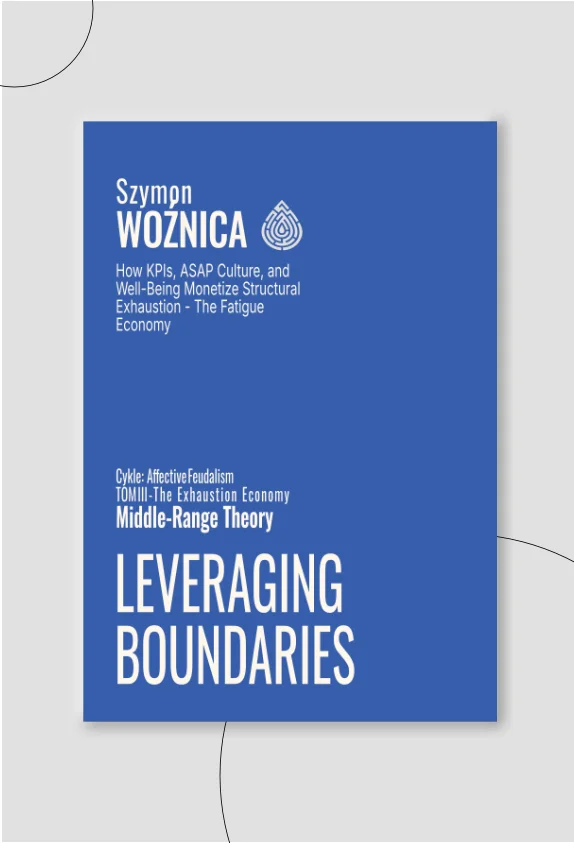
Leveraging Boundaries
How KPIs, ASAP Culture, and Wellbeing Monetise Exhaustion That Is Structural. Szymon Woźnica | Series: Affective Feudalism
For a decade, burnout was treated as an individual problem — poor time management, insufficient resilience, a failure of self-regulation. The system responded with a wellness industry: mindfulness apps, resilience training, mental health days. Turnover rates, quiet quitting, and chronic overload kept rising.
Woźnica applies engineering logic: if adding more protective buffers doesn’t stop the catastrophe, the model is wrong. Exhaustion in late capitalism is not a by-product of the system. It is its primary raw material.
The Theory of Boundary Leveraging
The book’s central concept maps how organisations shift the threshold of demands without open coercion — through stochastic pressure: asynchronous notifications, ambiguous KPIs, and a culture of permanent responsiveness. The result is C-FAS (Chronic Fragmented Attention Syndrome) and a mounting Attention Tax that workers pay simply for staying on standby.
Psychopolitics, Wellbeing, and Bullshit Jobs
Woźnica engages several theoretical traditions simultaneously. From Han he adopts psychopolitics and self-exploitation as indispensable analytical tools, extending them into the organisational dimension. From Fraser he draws the argument that capitalism is consuming the social foundations necessary for its own reproduction. From Graeber he takes the bullshit jobs thesis — reframing it not merely as a crisis of meaning, but as an active generator of exhaustion: work without genuine feedback loops drains cognitive resources without permitting recovery.
Wellbeing is deconstructed as reanimation, not regeneration — a UX layer applied to an overloaded system that restores the capacity to work without altering the structure of extraction. When wellbeing becomes a KPI, it ceases to be care and becomes a technology of crumbs.
Personal Economy and Cognitive Triage
The final section offers a constructive response. Woźnica introduces the Personal Economy — a framework for managing cognitive energy as a strategic resource — and Cognitive Triage as a tool for reorganising attentional architecture. This is not self-help: it is a response to C-FAS grounded in systems theory and agent-based modelling (ABM).
The volume includes an autoethnographic case study, an ABM simulation, an empirical data annex, and a practical anti-stress policy framework for organisations.
For: burnout researchers, labour sociologists, HR practitioners, readers of Han, Fraser, and Graeber.