


Affective Feudalism

Affect & Power in Late Capitalism

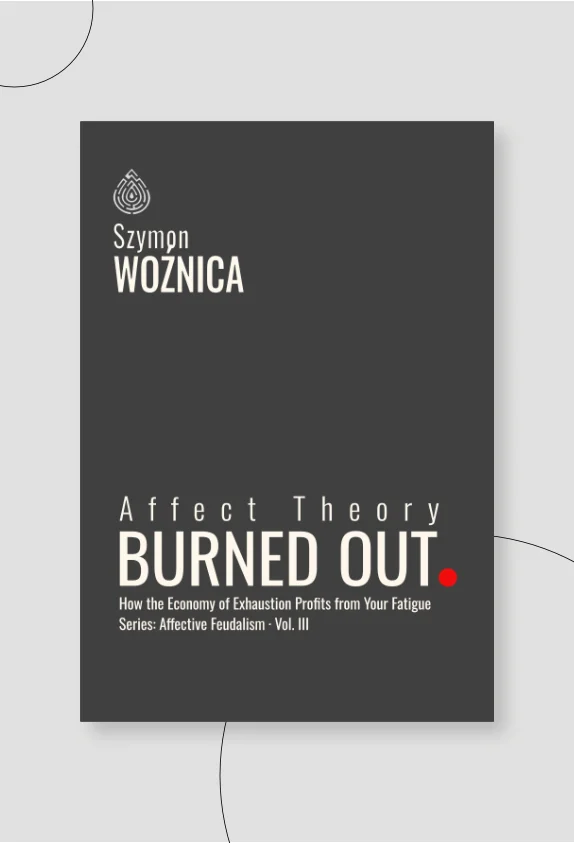
Burned Out – How the Exhaustion Economy Profits From Your Fatigue

32.00 

Burnout isn’t a system malfunction. It’s the system’s product. Burned Out reveals the mechanism that turns your fatigue into someone else’s profit — and the eight levers that shift the boundary of “normal” every single day. Third volume of the Affective Feudalism series.

Description

This isn’t another book about breathing exercises and work-life balance. It’s a book written against books like that.

Szymon Woźnica makes a claim that won’t let you rest easy: your burnout isn’t a personal character flaw. It’s fuel — and someone is profiting from it. In the third volume of the Affective Feudalism series, the author shows how the system stopped squeezing our working hours and started squeezing our affect instead: engagement, loyalty, the readiness to answer at 10 PM. He reveals eight “levers” used to shift the boundary of what we consider normal — until exploitation starts to look like ambition. And he makes the book’s sharpest claim: that the very system that burns you out later sells you the cure for burnout, profiting a second time.

This is a book for anyone who feels the weight of Monday looming on a Sunday evening — and for anyone who manages people and senses that something in the system doesn’t add up.

It doesn’t end in lament. It ends with a proposal: a path toward an economy where people stop being fuel.


How to Read This Book

INTRODUCTION

  • The Fatigue That Pays

PART I — DIAGNOSIS: THE ECONOMY THAT FEEDS ON YOU

Chapter 1. Fatigue Has Existed Before. Why This Is New

  • 1.1. The End of a Certain Diagnosis
  • 1.2. From Labor to Affect: What Is Being Squeezed Today
  • 1.3. A Regime, Not a Mood

Chapter 2. Ouroboros: How Society Devours Its Own Resources

  • 2.1. The Three Reservoirs of Energy: Body, Relationships, Meaning
  • 2.2. Hidden Debt: Regeneration on Credit
  • 2.3. Three Loops: Work, Compensation, Self-Optimization
  • 2.4. Why This Is Not a Matter of Character

Chapter 3. Affect as Raw Material

  • 3.1. Emotion Does Not Describe the World—It Sets It
  • 3.2. Lever, Currency, Rent
  • 3.3. The Inflation of Affect and the Erosion of Trust

Chapter 4. A Short Lecture on the Lever

PART II — THE MECHANISM: BOUNDARY LEVERAGING

Chapter 5. The Theory of Boundary Leveraging

  • 5.1. What I Call a Boundary
  • 5.2. The Principle of the Lever: A Real Reward Turned into a Symbol
  • 5.3. Deniability as a Design Feature
  • 5.4. Three Phases: Test, Normalization, Exploitation

Chapter 6. The Eight Levers for Shifting Normality

  • 6.1. The Measurement Lever
  • 6.2. The Moralization Lever
  • 6.3. The Status Lever
  • 6.4. The Uncertainty Lever
  • 6.5. The Fragmentation Lever
  • 6.6. The Symbolic-Reward Lever
  • 6.7. The Comparison Lever
  • 6.8. The Architecture Lever

Case Study: Boundary Leveraging in Corporate Practice—An Auto-Ethnography of the Mechanism (Foundations of the Theory)

  • 1. The Epistemic Status of This Chapter
  • 2. Case One: Restructuring as a Generator of Temporal Leveraging
  • 3. Case Two: Fruit as a Micro-Lever of Symbolic Reward
  • 4. Case Three: Coaching as a Path to the Exit
  • 5. Case Four: The Weekend C-FAS
  • 6. Cross-Sectional Analysis: What Unites These Four Cases
  • 7. Conclusions for the Theory

Chapter 7. The Newspeak of Care: Language as a Shock Absorber

  • 7.1. Words That Extinguish
  • 7.2. The Capture of the Language of Emancipation
  • 7.3. Reclaiming Precision

Chapter 8. The Great Loop: How the Norm Returns as Compulsion

PART III — MONETIZATION: KPIs, WELLBEING, AND THE RELIEF MARKET

Chapter 9. KPIs as a Language of Domination

  • 9.1. KPIs Do Not Measure the World—They Establish It
  • 9.2. The Audit Society and Goodhart’s Law
  • 9.3. The Costs the Measure Does Not See

Chapter 10. Wellbeing as a Ventilator

  • 10.1. Regeneration vs. Resuscitation
  • 10.2. Wellbeing as the UX of Overload
  • 10.3. The Privatization of Responsibility
  • 10.4. The Relief Market: From Stimulation to Sedation
  • 10.5. When Care Becomes Symbolic Violence

Chapter 11. The Psychologization of Suffering

  • 11.1. “It’s Your Psyche”
  • 11.2. “Take Care of Yourself” as a Political Sentence
  • 11.3. Suffering as Demand

Chapter 12. Burnout as Strategy: Burn and Replace

  • 12.1. Breaking with Psychologization
  • 12.2. The Churn Economy
  • 12.3. Stochastic Pressure as Fuel
  • 12.4. Why We Consent to This Game

PART IV — STATUS, POLARIZATION, AND SOCIAL ENERGY

Chapter 13. Prisoners of Status

  • 13.1. Prestige as Medicine
  • 13.2. Status as Currency
  • 13.3. Status as Prison

Chapter 14. Homeostasis as a Trap

  • 14.1. The Politics of “Not Losing”
  • 14.2. Comfort as Loyalty

Chapter 15. Fatigue as the Fuel of Conflict

  • 15.1. A Lower Threshold of Complexity
  • 15.2. Tribe Instead of Politics
  • 15.3. Polarization as an Attention Business Model
  • 15.4. Conflict Instead of Redistribution

PART V — THE GEOGRAPHY OF EXHAUSTION

Chapter 16. The USA: The Laboratory

Chapter 17. Europe: Exhaustion as Procedure

Chapter 18. Poland: The Periphery of the Core

  • 18.1. Importing the Protocol Without Shock Absorbers
  • 18.2. SSCs, “Korpo,” and “Mordor”
  • 18.3. Aspiration, Fear, Imitation of the Center
  • 18.4. The Young Adrift
  • 18.5. The State of Affect: Administration, Education, Health

PART VI — IMPLOSION: HOW SUCH A SYSTEM ENDS

Chapter 19. Why the System Does Not Explode but Caves In

  • 19.1. Two Models of the End
  • 19.2. The Long Tail of Implosion: Slow Catastrophes

Chapter 20. The Shrinking Loop: When the Reset Stops Working

Chapter 21. The New Order: Reform as a Mask for a Restart

  • 21.1. Restart Instead of Reform
  • 21.2. Five Recognizable Signs

Chapter 22. The Council of Peace and the Aesthetics of Calm

PART VII — BREAKING THE CYCLE: TOWARD THE PERSONAL ECONOMY

Chapter 23. Why “Take Care of Yourself” Is Not Enough

Chapter 24. Counter-Levers: Organization, State, Culture, Technology

  • 24.1. In Organizations
  • 24.2. In the State
  • 24.3. In Culture
  • 24.4. In Technology

Chapter 25. The Infrastructure of Collective Resilience

Chapter 26. Affective Resistance: A Repertoire of Micro-Resistance

Chapter 27. A New Ethic of Social Energy

Chapter 28. The Personal Economy: A Phase Transition

CONCLUSION

  • Reclaiming the Future

EPILOGUE

  • A Last Sentence Along the Way

EMPIRICAL APPENDICES

  • Methodological Note
  • The Epistemic Status of the Appendix

Appendix A. The Economy of Exhaustion in Numbers

Appendix B. Case Study: The Ritual of Neutralization (a Reconstruction)

  • Description
  • Observable Indicators
  • Interpretation

Appendix C. Stochastic Pressure and the Hypervigilance Index

  • Hypothesis
  • Contextual Data
  • An Original Hypervigilance Index (a Proposal)
  • Interpretation

Appendix D. The Churn Matrix

  • Model
  • Interpretation

Appendix E. ABM Simulation: Leveraging and Counter-Levers

  • The Purpose of the Simulation
  • The Model’s Assumptions
  • Hypotheses Tested
  • Methodological Conclusion
  • Limits of the Model

Appendix F. Legislation as a Counter-Lever: The Right to Be Offline

  • Why Legislation Is Empirical Proof
  • Chronology: From France to Directives
  • Interpretation in the Frame of the Economy of Exhaustion
  • Resistance to the Counter-Lever

Appendix G. The Boundary Conditions of the Theory

GLOSSARY OF KEY CONCEPTS

  • A Map of Concepts

BIBLIOGRAPHY

  • Consolidated Bibliography
  • A Note on Editions

ABOUT THE AUTHOR AND THE PROJECT

  • About the Author
  • About the Project: Affective Feudalism

Additional information

Publication year

2026

Pages

246

Format

PDF

Download a free sample chapter to see what awaits you inside.

Download PDF Sample (English)

Pobierz fragment PDF (Polski)

Related products

USD / PLN
PLN Polish złoty